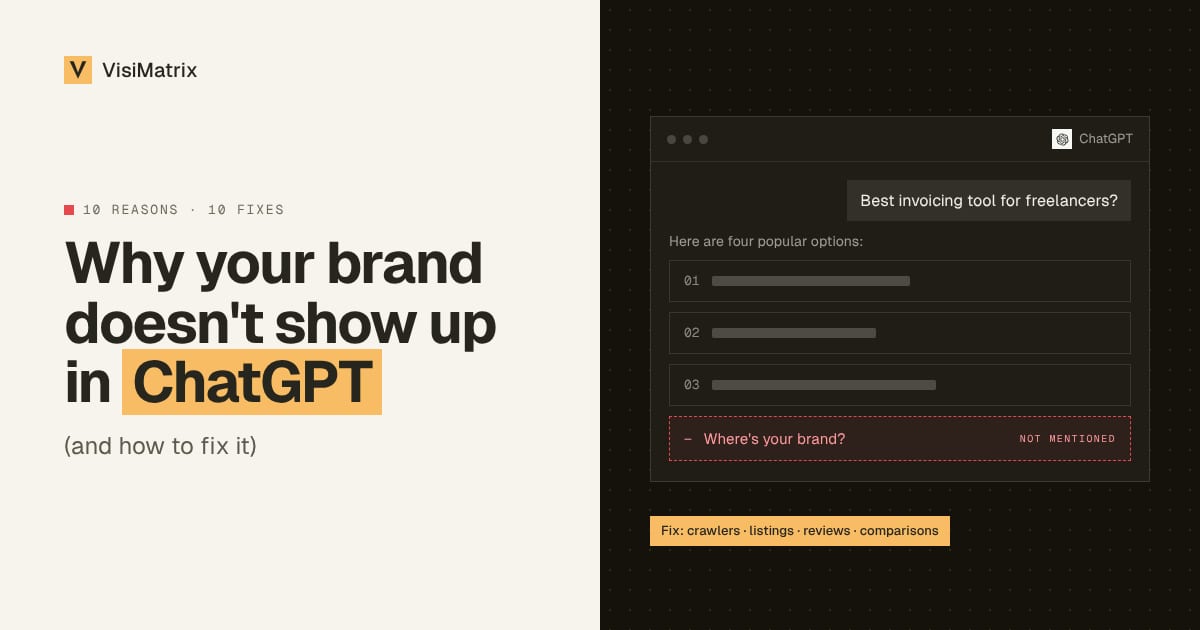
You open ChatGPT and type the question your customers ask: "What's the best invoicing tool for freelancers?" It answers in seconds with four names. Two of them you compete with every day. One you've never heard of. Yours isn't there.
You try again with different wording. Still not there. You ask directly, "What do you know about [your brand]?", and it either gets the basics wrong or says it doesn't have much information.
It's a frustrating moment, especially if you rank well on Google, have happy customers and a product that's better than half the list. But it's rarely random. When ChatGPT leaves a brand out, there's almost always a specific reason, and most of those reasons can be fixed.
This guide walks through the ten most common ones, how to tell which apply to you, and what to do about each.
Why this matters more than it did a year ago
ChatGPT passed 900 million weekly active users in February 2026. A growing share of those people use it the way they used to use Google: to research what to buy, which tool to pick, which agency to hire.
The difference is what they get back. Google gives ten links and lets the person choose. ChatGPT gives a short written answer with a handful of names and a reason for each. If you're not in that answer, the buyer often doesn't scroll further, because there's nothing to scroll. They move on with the shortlist they were given.
That's why the question "does ChatGPT mention us?" has become as important as "where do we rank?". Both are part of your AI Visibility.
First, check properly
Before you try to fix anything, make sure you know what's actually happening. A single question in your own ChatGPT account can mislead you in both directions.
Use a clean session. ChatGPT can use your past conversations and memory. If you've spent weeks talking to it about your company, it may mention you more easily than it would for a stranger. Test in a logged-out browser or a temporary chat.
Ask many questions, not one. Write 20 to 30 questions your buyers really ask. Mix three kinds:
Category questions: "best project management tool for agencies"
Comparison questions: "Asana vs Monday" or "alternatives to Trello"
Problem questions: "how do I stop missing client deadlines"
Repeat over time. Answers change from day to day and with small changes in wording. One check is a snapshot. A few rounds over two or three weeks show you the real pattern.
Note what you see. For each answer, record whether you're mentioned, where you appear, how you're described, which competitors show up and which websites ChatGPT cites.
If you'd rather not do this by hand, VisiMatrix runs your questions in ChatGPT and six other assistants every week, and gives you a visibility score from 0 to 100 along with your mention rate, average position, sentiment and citations. Either way, once you have a baseline, you can start working through the reasons below.
How ChatGPT decides what to say
It helps to understand where ChatGPT's answers come from, because each source points to a different kind of fix.
ChatGPT draws on two things. The first is what the model learned during training: a huge snapshot of the web, books and other text, frozen at a cutoff date. The second is live search. For many questions, especially about products, prices and "best" lists, ChatGPT searches the web in real time, reads a selection of pages and writes its answer from them, often with links.
So a brand can be missing for two broad reasons. Either the model didn't learn enough about it in training, or the live search didn't find or trust pages that mention it. Most of the fixes below work on the second, because it responds to what you do now. The first catches up over time as the web says more about you.
Now, the reasons.
Reason 1: ChatGPT can't reach your website
This is the most common technical cause and the easiest to fix, yet many brands don't know it's happening.
OpenAI runs several crawlers, and they do different jobs. According to OpenAI's own documentation, OAI-SearchBot is the one that decides whether your site can appear in ChatGPT's search answers. GPTBot collects content for training future models. ChatGPT-User fetches a page when a user asks ChatGPT to look at it.
If your robots.txt blocks OAI-SearchBot, ChatGPT's search can't use your pages. Many sites blocked "AI bots" wholesale in 2023 and 2024 with a single rule, and are still blocking the crawler that would now bring them visibility.
How to check: open yoursite.com/robots.txt and look for any of these user agents with Disallow: /. Also look for a catch-all rule like User-agent: * with Disallow: /, which blocks everything.
How to fix it: allow the search crawlers explicitly.
txt
User-agent: OAI-SearchBot
Allow: /

User-agent: ChatGPT-User
Allow: /
Whether to allow GPTBot is a separate choice. Blocking it keeps your content out of training data, but doesn't stop you appearing in ChatGPT search.
Robots.txt isn't the only gate. Firewalls, CDN bot protection and security plugins can challenge or block crawlers they don't recognise, even when robots.txt allows them. Check your Cloudflare or hosting settings for AI-bot blocking. OpenAI notes that robots.txt changes can take about 24 hours to take effect.
One more thing to check: if your site builds its content with JavaScript in the browser and sends almost nothing in the initial HTML, some crawlers may see an empty page. Server-side rendering or pre-rendering your key pages removes that risk.
The VisiMatrix Site Audit checks your robots.txt for blocked AI crawlers and gives you the exact lines to paste, with instructions for where the file lives on Shopify, WordPress, Webflow and other platforms.
Reason 2: There isn't enough written about you
ChatGPT recommends brands it has seen discussed. If the only place your brand is described in detail is your own website, there's very little for it to go on.
This hits new brands hardest. A product launched last year may postdate the model's training data entirely, which leaves live search as the only route in. And live search has to find pages that talk about you.
How to tell: search your brand name on Google and look past your own site. How many independent pages describe what you do? Reviews, articles, directory listings, forum threads, podcast notes? If the answer is "a handful", this is probably a big part of the problem.
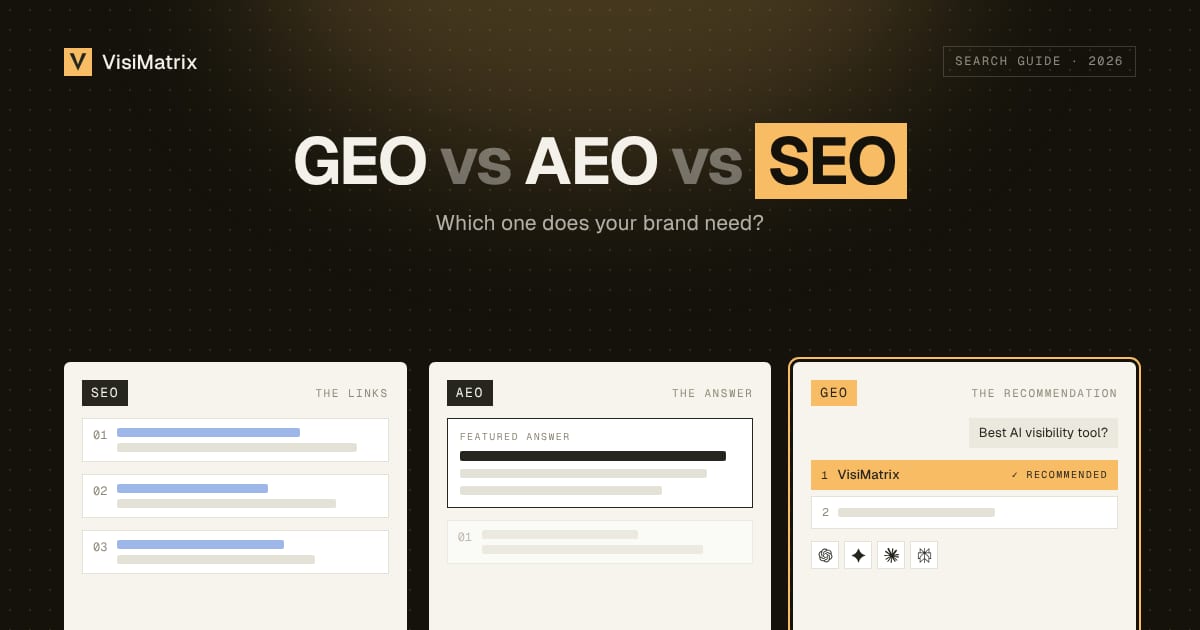
How to fix it: you need more of the web to talk about you, in places that are likely to be read. The next three reasons cover where. The short version: get listed, get reviewed, get compared and get discussed.
Reason 3: You're not on the sites ChatGPT trusts
When ChatGPT answers "what's the best X for Y?", it leans heavily on pages built to answer exactly that: review platforms, software directories, "best of" roundups, comparison sites and alternatives pages. If you're absent from those, you're absent from the material the answer is built from.
How to tell: ask ChatGPT a few category questions and look at the sources it cites. You'll quickly see a pattern of the same kinds of sites coming up. Then check whether you're listed on them.
How to fix it: get listed, with complete profiles. The sites that matter depend on your industry, but for most software and online businesses they include:
Launch platforms: SoftLaunching, Product Hunt, Hacker News (Show HN), Indie Hackers, BetaList
Review sites: G2, Capterra, TrustRadius
Alternatives and directories: AlternativeTo, SaaSHub, There's An AI For That
Brand profiles: Crunchbase, Wikidata, LinkedIn, Google Business Profile (if you serve customers in person)
The 90-day plan inside VisiMatrix includes 20 of these sites, with links, in the order we recommend working through them. Starting with SoftLaunching gets you a first listing in minutes.
A bare listing helps a little. A listing with reviews helps much more. Ask your existing customers for honest reviews on one or two of these platforms. A profile with twenty genuine reviews says far more about you than an empty one.
Reason 4: Nobody compares you to anyone
A huge share of buying questions are comparisons. "X vs Y." "Alternatives to X." "Best tools like X." ChatGPT answers these by reading pages that make those comparisons. If no page compares you with the brands in your category, you don't get a seat at the table.
How to tell: ask ChatGPT "what are the best alternatives to [your biggest competitor]?" If you're not in the answer, look at the pages it cites. Those are the comparisons you're missing from.
How to fix it: two moves.
First, publish your own comparison pages: "[Your brand] vs [Competitor]" and "[Competitor] alternatives". Be honest. A page that admits where a competitor is stronger reads as trustworthy to both people and AI, and it's far more likely to be quoted than a page claiming you win on everything.
Second, get into other people's comparisons. Find the "best tools for X" articles that rank in your category and that ChatGPT cites. Contact the authors with a short, useful pitch: what you do, who it's for and why it fits their list. Many roundups are updated regularly and their authors welcome new options.
Reason 5: Your website doesn't say clearly what you do
Look at your homepage as if you'd never heard of your company. Can you tell, in the first two lines, what it is, who it's for and what category it belongs to?
Many brand sites open with lines like "Work, reimagined" or "The future of growth". People skim past these. AI systems can't place you from them. If ChatGPT can't tell that you're an invoicing tool for freelancers, it won't recommend you when someone asks for one.
How to tell: ask ChatGPT, in a clean session, "What does [your brand] do?" If the answer is vague or wrong, your own pages aren't doing their job.
How to fix it:
Say what you are, plainly. Your homepage headline or the line under it should name your category and your customer: "Invoicing software for freelancers and small studios."
Use the words your buyers use. If people search for "CRM", say CRM, not "relationship intelligence platform".
Add Organization structured data that states your name, website, logo, a one-sentence description and links to your profiles elsewhere (the
sameAsproperty). This helps search engines and AI systems connect your website, your listings and your social profiles as one brand.Have a clear About page that explains what you do, who's behind it and where you're based.
VisiMatrix generates Organization schema, FAQ schema and an llms.txt file for your site, with a preview and copy button for each.
Reason 6: Your brand information is inconsistent
ChatGPT builds its picture of your brand from many sources. If they disagree, the picture gets blurry.
Common problems:
Different descriptions on different sites ("email marketing platform" on one, "CRM" on another, "growth tool" on a third)
An old name, old pricing or discontinued features still listed in directories
Different spellings of your brand name
A brand name that's also a common word or shared with another company
That last one deserves attention. If your brand is called "Beacon" or "Nova", ChatGPT has to work out which of many Beacons someone means. Without strong, consistent signals, it may describe a different company or skip you to avoid confusion.
How to fix it:
Write one short description of your brand and use it, word for word or close to it, on every profile and listing.
Update or remove outdated listings with old names, prices and features.
Spell your name the same way everywhere.
If your name is ambiguous, pair it with your category in key places ("Beacon Analytics" or "Beacon, the uptime monitor") and make sure your structured data links your profiles together.
Reason 7: Your content isn't easy to quote
Even when ChatGPT finds your pages, it has to be able to lift something useful from them. Long introductions, vague claims and pages that never answer the question directly give it little to work with.
Research supports making content more quotable. In the 2023 study that coined the term "generative engine optimization", researchers from Princeton and IIT Delhi tested ways of rewriting web content and measured how visible it became in AI-generated answers. Adding relevant quotations improved visibility by about 41% on their main measure, adding statistics by about 31% and citing sources by about 27%. Keyword stuffing performed worse than doing nothing.
How to fix it:
Answer first. Under each heading, put the direct answer in the first sentence or two, then the detail.
Use specific facts. Prices, numbers, timeframes, named features. "Plans start at $12 a month" is quotable. "Affordable pricing for every team" isn't.
Back claims with sources. Link to research, data and named experts where you can.
Structure for scanning. Clear headings, short paragraphs, lists where they help and FAQ sections for common questions.
Write pages for the questions buyers ask. If people ask ChatGPT "how much does [category] cost?", have a page that answers that clearly.
Reason 8: You're checking the wrong questions
Sometimes the problem isn't that ChatGPT ignores you. It's that you're testing questions where you were never going to appear.
If you sell accounting software for restaurants and test "best accounting software", you're competing with every major player in the category. ChatGPT will list the biggest names. That doesn't mean it ignores you for "best accounting software for restaurants", which is the question your actual buyers ask.
How to tell: split your test questions into broad and specific. If you're missing from broad questions but appear in specific ones, that's normal for a focused brand, and the specific ones are what matter.
How to fix it:
Build your question list from real buyer language: sales calls, support tickets, Reddit threads and Google's "People also ask" boxes.
Focus on the niche you actually serve, and make sure your site and listings name that niche clearly.
Track broad questions too, but judge your progress on the specific ones first.
Reason 9: Your competitors own the conversation
ChatGPT's answers are short lists. Every spot taken by a competitor is one you don't have. Often the brands that appear aren't better products. They've simply been talked about more in the places AI reads.
How to tell: look at which competitors appear most often across your questions, and at the sources ChatGPT cites when it recommends them. You'll usually find a handful of articles, review sites or directories doing a lot of the work.
How to fix it: treat those sources as your target list.
If a competitor appears because of a particular roundup, pitch that roundup's author.
If they appear because of strong reviews on G2 or Capterra, build your own review base there.
If they appear because of a Reddit thread, take part helpfully in that community. Answer the question first and mention your product only where it genuinely fits.
If they appear because they have comparison pages and you don't, write yours.
VisiMatrix's Competitive Intel shows which brands AI recommends instead of you and for which questions, and the Citations view shows which domains it relies on, including where competitors are cited and you aren't.
Reason 10: You're mentioned, but badly
This last one is a different problem from not showing up, but it often hides inside it. ChatGPT may mention you and describe you wrongly: an old price, a feature you removed, a market you don't serve, or a negative point from a complaint thread years ago.
A wrong mention can be worse than none, because the buyer leaves with a false picture.
How to tell: ask ChatGPT directly about your brand, your pricing and how you compare with competitors. Check every fact.
How to fix it:
Find the source. Inaccurate details usually come from an outdated page on your own site, an old directory listing or a third-party article.
Fix your own pages first, then update listings, then ask article authors for corrections.
For negative points, address them publicly where they appeared, if they've been resolved, and make sure newer, accurate information exists in places AI reads, such as recent reviews and an up-to-date FAQ.
Check again after a few weeks to see whether the answers have changed.
What to fix first
Ten reasons is a lot. Here's the order we'd work in, because each step makes the next one more effective.
Week 1: open the door and get a baseline. Check robots.txt, firewall and CDN settings so OAI-SearchBot and ChatGPT-User can reach your site. Write your list of buyer questions and record where you stand today.
Weeks 2 to 3: fix your own house. Rewrite your homepage so it says plainly what you do and for whom. Add Organization and FAQ schema. Make your top pages answer-first with specific facts. Publish one honest comparison page.
Weeks 3 to 6: get listed and reviewed. Create complete, consistent profiles on the launch platforms, review sites and directories in your category. Ask customers for reviews on one or two of them. Update or remove outdated listings.
Months 2 to 3: earn mentions. Pitch the roundup articles ChatGPT cites. Take part in communities where your buyers ask questions. Publish more comparison and "how to choose" content. Keep checking your questions each week to see what's working.
The VisiMatrix 90-day plan follows this order: a 19-item website setup checklist, 20 listing sites and a 13-week roadmap of weekly tasks.
How long does it take?
It depends on where you start and how crowded your category is, so be wary of anyone promising a timeline.
What we can say is that the fixes work at different speeds. Unblocking a crawler can matter within days, once ChatGPT's search can read your pages again. Clearer pages and structured data help as soon as they're crawled. Listings, reviews and third-party mentions build up over weeks and months, and they tend to have the biggest effect on whether you're recommended rather than just mentioned.
That's why tracking matters. Without a baseline and regular checks, you can't tell which changes moved the needle. For a walkthrough of the metrics and how to read them, see our guide on how to Track AI Visibility.
A quick checklist
If you only have an hour today, check these:
Your robots.txt allows OAI-SearchBot and ChatGPT-User
Your firewall or CDN doesn't block AI crawlers
Your homepage says what you do and for whom in the first two lines
You have Organization schema with
sameAslinks to your profilesYour brand description is the same across your site and listings
You're listed on at least three review sites or directories in your category
You have at least one honest comparison page
You have a list of 20 or more real buyer questions to track
Frequently asked questions
Why does ChatGPT recommend my competitors but not me?
Usually because your competitors are discussed more in the places ChatGPT reads: review sites, directories, roundup articles, comparison pages and communities. It can also be a technical issue, such as your robots.txt blocking OAI-SearchBot, or your website not stating clearly what you do.
Can I pay to appear in ChatGPT's answers?
No. ChatGPT's recommendations aren't sold the way search ads are. Getting mentioned comes from being reachable, clear and well discussed across the web.
Does blocking GPTBot stop me appearing in ChatGPT?
Not in ChatGPT search. GPTBot collects content for training. OAI-SearchBot handles search. You can block GPTBot and still allow OAI-SearchBot, so your pages can appear in ChatGPT's search answers.
Does ranking on Google mean I'll show up in ChatGPT?
Not necessarily. Strong SEO helps, because crawlable, well-structured pages and backlinks support both. But ChatGPT leans heavily on third-party sources like reviews, directories and comparison articles, so a brand can rank well on Google and still be missing from ChatGPT's answers.
How do I know if my fixes are working?
Track the same set of buyer questions on a schedule and compare. Watch whether you're mentioned more often, appear higher in lists, are described more accurately and get cited as a source. A rising trend over several weeks is what to look for, since single answers vary.
My brand is new. Is it worth trying yet?
Yes. New brands are often missing from the model's training data, which makes live search the main way in. Being crawlable, clearly described and listed on trusted sites gives ChatGPT's search something to find from day one.
Find out where you stand
You can't fix what you haven't measured. Create a free VisiMatrix project, add the questions your buyers ask, and see whether ChatGPT and six other AI assistants mention you, how they describe you and which competitors they recommend instead. The free plan includes 50 monthly credits and one project, with no card required.