Ask ChatGPT "what's the best project management tool for a small agency?" and you get a short list. Three or four names, a sentence on each, maybe a link. If your product isn't on that list, the buyer never hears about you, and you never see the visit in your analytics.
That short list is what AI search visibility means: how often AI assistants mention your brand, where you sit in their answers, and whether they cite your website as a source.
It matters more every month. ChatGPT passed 900 million weekly active users in February 2026, and Google now puts an AI answer above the results for a large share of searches. When an AI Overview appears, Ahrefs found the top-ranking page gets 58% fewer clicks than the same position did before AI Overviews. A randomized field experiment from the Indian School of Business and Carnegie Mellon put the drop in organic clicks at 38%. Ranking first still counts, but being named inside the answer counts too.
Here's how to improve your AI search visibility, in the order we'd do it.
1. Measure where you stand first
You can't improve what you've never checked, and most brands have no idea what AI says about them. Typing a few questions into ChatGPT yourself gives you a hint, but answers change by assistant, by wording and by day.
Start with a baseline:
Write down 20–50 questions your buyers actually ask, such as "best CRM for real estate agents", "alternatives to [your biggest competitor]" or "how do I fix slow Shopify checkout".
Run each one across the assistants your buyers use.
Record whether you're mentioned, where you rank in the answer, how you're described, and which websites get cited.
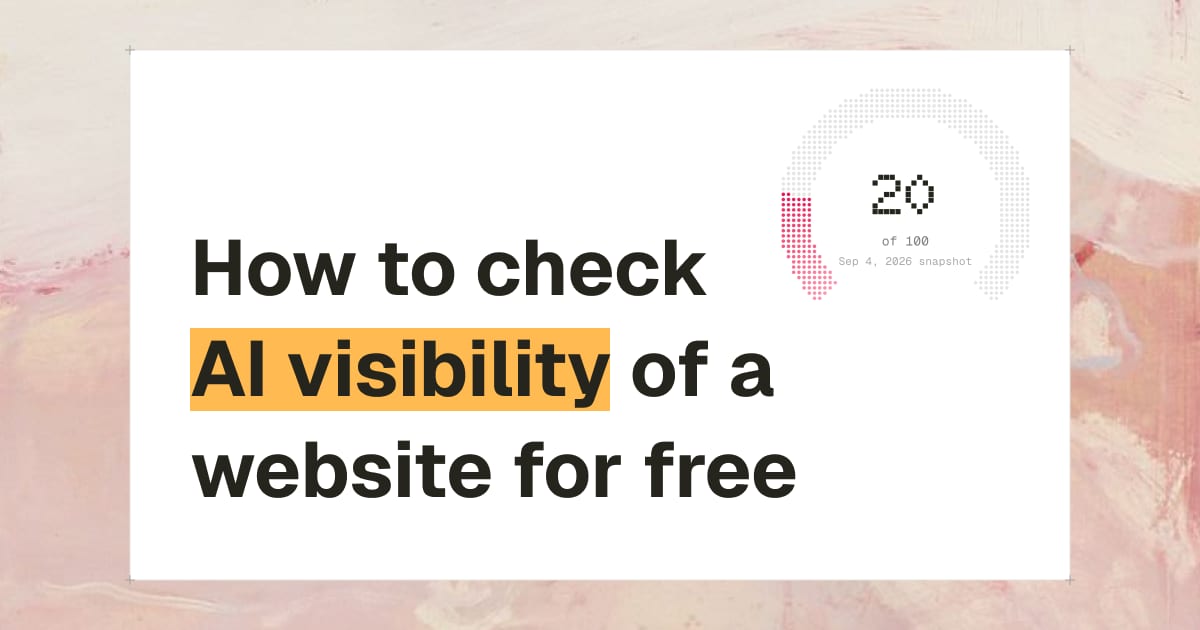
VisiMatrix does this for you. Add your site and your prompts, and it runs them across seven assistants (ChatGPT, Gemini, Claude, Perplexity, DeepSeek, Mistral and Grok) every week. You get one visibility score from 0 to 100, plus the numbers behind it:
Signal | What it tells you |
|---|---|
Mention rate | How often AI names your brand across all answers |
Average rank | Where you appear when AI gives a list |
Sentiment | Whether AI describes you positively |
Own-site citations | How often AI links to your website as a source |
A score of 0–20 means AI rarely mentions you, 21–80 means you show up for some questions, and 81–100 means AI recommends you often and cites your site. Most brands start in the bottom band, and that's fine. You need the baseline to know which fixes worked.
2. Let AI crawlers into your site
Assistants can only quote pages they can read. Plenty of sites block AI crawlers without knowing it, through an old robots.txt rule, a security plugin or a CDN setting.
Each company runs more than one crawler, and they do different jobs. OpenAI's documentation is clear about this: OAI-SearchBot decides whether your site can appear in ChatGPT search answers, while GPTBot only collects content for model training. Blocking GPTBot keeps you out of training data. Blocking OAI-SearchBot keeps you out of ChatGPT's answers.
If you want to be found in AI search, your robots.txt should allow the search crawlers:
User-agent: OAI-SearchBot
Allow: /

User-agent: ChatGPT-User
Allow: /

User-agent: PerplexityBot
Allow: /

User-agent: Claude-SearchBot
Allow: /

User-agent: Googlebot
Allow: /
Whether to allow training crawlers like GPTBot is a separate decision, so make it on purpose.
Then check the rest of your stack. A firewall or bot-protection rule that challenges unknown user agents can block these crawlers even when robots.txt allows them. OpenAI notes that robots.txt changes can take about 24 hours to take effect.
The VisiMatrix Site Audit checks your robots.txt for blocked AI crawlers and shows the exact lines to paste, with a guide for where the file lives on Shopify, WordPress, Webflow and other platforms.
3. Make your pages easy to quote
AI assistants pull short, clear answers. A page that opens with three paragraphs of brand story before it gets to the point gives them little to work with.
Answer first. Put the direct answer in the first sentence or two under each heading, then the detail. If the question is "how much does X cost?", the price goes up top.
Write the comparison pages buyers search for. "X vs Y", "best tools for Z" and "alternatives to X" are exactly the questions people ask AI. If the only pages answering them belong to your competitors, those are the pages AI will read. Be fair in your comparisons. A page that admits where a competitor is stronger is more believable to readers and more useful to quote.
Add structured data. Organization schema tells search engines and AI systems who you are, what you do and where else you exist online. Here's the shape, using VisiMatrix as the example:
<script type="application/ld+json">
{
  "@context": "https://schema.org",
  "@type": "Organization",
  "name": "VisiMatrix",
  "url": "https://visimatrix.com",
  "logo": "https://visimatrix.com/brand/visimatrix-mark-512.png",
  "description": "AI visibility platform that tracks how AI assistants mention, rank and cite your brand.",
  "sameAs": [
    "https://www.linkedin.com/company/visimatrix",
    "https://www.producthunt.com/products/visimatrix"
  ]
}
</script>
Add FAQ schema to pages that answer common questions. The sameAs links matter: they connect your website to your profiles elsewhere, so systems recognise them as one brand.
Consider an llms.txt file. It's a proposed standard: a plain-text summary of your site and its key pages, placed at yoursite.com/llms.txt. Major assistants haven't confirmed they use it, so treat it as cheap insurance rather than a ranking factor.
VisiMatrix generates the robots.txt rules, Organization schema, FAQ schema and llms.txt for your site, with a preview and a copy button for each.
4. Get listed where AI looks for brands
When an assistant answers "what's the best tool for…", it leans on sources that list and review products: launch platforms, review sites, directories and "alternatives to" pages. If your brand isn't on them, AI has fewer places to learn about you.
The 90-day plan inside VisiMatrix includes 20 launch and listing sites, with links, in the order we recommend:
Launch platforms: SoftLaunching, Product Hunt, Hacker News (Show HN), Indie Hackers, BetaList, Microlaunch, Uneed, Peerlist Launchpad
Review sites: G2, Capterra / GetApp, TrustRadius
Alternatives and AI directories: AlternativeTo, SaaSHub, There's An AI For That, Futurepedia, Toolify
Brand profiles: Crunchbase, Wikidata, LinkedIn company page, Google Business Profile
Start with SoftLaunching. It takes a few minutes and brings your first visitors. Then work down the list.
Two things make listings count:
Use the same name, description and logo everywhere. Consistency helps AI connect every listing back to one brand.
Collect reviews. A listing with honest reviews says far more than an empty profile. Ask your first users directly.
5. Earn mentions on other people's sites
Your own site tells AI what you say about yourself. Third-party mentions tell it what others say about you, and assistants weigh both.
The places worth your time:
Communities. Helpful answers on Reddit, Quora and niche forums, where people ask the same questions they ask AI. Answer the question first, and mention your product only where it actually fits.
Roundups and comparisons. Articles like "best tools for X" are cited by AI constantly. Find the ones in your category and ask the authors to consider you.
Guest articles and podcasts. Each one is another trusted page that names your brand.
Partnerships. Integrations and partner pages put your name on sites AI already trusts.
To find where to focus, look at who AI cites today. VisiMatrix's Citations view shows which domains assistants cite for your prompts and where competitors are cited and you aren't, so you know which sites to approach first.
6. Watch your competitors
AI answers are a short list, so every spot a competitor holds is one you don't. VisiMatrix's Competitive Intel shows which brands AI recommends instead of you, for which questions, and which sources it uses to back them up.
That turns vague advice into a specific job. If AI keeps recommending a competitor for "best X for small teams" and citing a comparison article to do it, that article and that question are where you start.
7. Track weekly and fix the gaps
AI visibility moves slowly, then all at once. A new review, a comparison page or a fixed robots.txt can change answers within weeks, and a competitor's launch can change them back.
Re-run your prompts on a schedule and compare. VisiMatrix runs your project weekly, shows how your score changed since the last run, and flags the assistants that still don't mention you, along with what to do about it.
A 30-day starter plan
If you're starting from zero, here's a realistic first month:
Week | Focus | Tasks |
|---|---|---|
1 | Baseline and access | Set up your prompts and get your first visibility score. Fix robots.txt and any firewall rules blocking AI search crawlers |
2 | Your own site | Add Organization and FAQ schema. Rewrite your top three pages answer-first. Publish one honest comparison page |
3 | Listings | List on SoftLaunching, Product Hunt, G2, Capterra, AlternativeTo and Crunchbase with matching details. Ask five customers for reviews |
4 | Mentions | Answer five real questions in communities. Pitch two roundup articles. Re-run your prompts and compare with week 1 |
The full 13-week roadmap in VisiMatrix carries this through 90 days, covering articles, backlinks, email and outreach.
Frequently asked questions
What is AI search visibility?
AI search visibility is how often AI assistants such as ChatGPT, Gemini, Claude and Perplexity mention your brand, where you rank in their answers, and whether they cite your website. It's the AI version of ranking in search results.
How is AI visibility different from SEO?
SEO aims to rank your pages in a list of links. AI visibility aims to get your brand named inside the answer itself. They overlap, since crawlable pages, clear content and backlinks help both, but AI visibility also depends on listings, reviews and mentions on other sites.
How long does it take to improve AI search visibility?
It depends on where you start and how competitive your category is. Crawler and structured-data fixes are quick to make. Listings, reviews and third-party mentions build over weeks and months, which is why tracking weekly matters.
Should I block GPTBot?
GPTBot collects content for training OpenAI's models. It doesn't control whether you appear in ChatGPT search, which is handled by OAI-SearchBot. You can block GPTBot and still allow OAI-SearchBot.
How do I check if ChatGPT mentions my brand?
Ask it the questions your buyers ask, and repeat across assistants and over time, since answers vary. To track this properly, a tool like VisiMatrix runs your prompts across seven assistants every week and gives you a visibility score.
See what AI says about you
You can't improve your AI visibility without knowing where you stand. Create a free VisiMatrix project to run your first analysis. The free plan includes 50 monthly credits and one project, with no card required.