Search "best accounting software for freelancers" on Google and three different things can happen on one screen. Ten blue links, ranked. A featured snippet or AI Overview at the top, giving a direct answer. And if the same person asks ChatGPT instead, a short written recommendation with three or four brand names and no list of links at all.
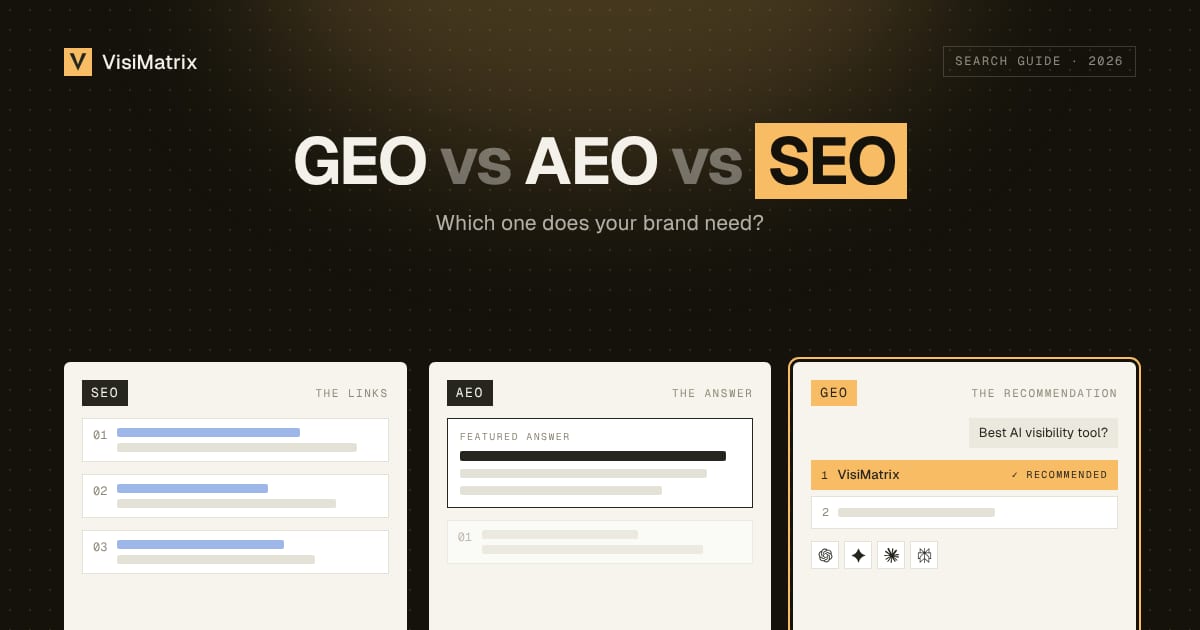
Each of those results has its own name for the work of getting into it. SEO is about the links. AEO is about the direct answer. GEO is about the AI-written recommendation. Marketers argue about which one matters most, but your buyers move between all three without noticing, and your brand needs to show up wherever they look.
Here's what each one means, where they overlap, and how to decide where to start.
SEO: ranking in the list of links
Search engine optimization is the oldest of the three and still the foundation. The goal is to rank your pages high in Google and Bing results for the searches your buyers make, so they click through to your site.
SEO covers three areas:
Technical: search engines can crawl, render and index your pages quickly.
On-page: your content matches what the searcher wants, with clear titles, headings and internal links.
Off-page: other sites link to you, which signals that your pages are worth trusting.
Success is measured in rankings, organic clicks and the traffic and sales that follow.
AEO: being the direct answer
Answer engine optimization grew up around featured snippets, "People also ask" boxes and voice assistants like Siri and Alexa. Instead of ten links, the engine picks one answer and shows it, or reads it aloud. AEO is the work of becoming that answer.
That means:
Answering a specific question clearly, in the first sentence or two under a heading that asks it.
Structuring content as questions and answers, steps, short lists and definitions.
Adding FAQ and HowTo structured data, so engines can lift the answer cleanly.
Google's AI Overviews pushed AEO further. The answer box is now often an AI-written summary that pulls from several pages, so being a clear, quotable source matters more than ever. AEO is measured in snippet wins, answer-box appearances and the traffic those bring, which is often less than a ranked link, since the searcher already has the answer.
GEO: being recommended by AI assistants
Generative engine optimization is the newest term. Researchers from Princeton and IIT Delhi coined it in a 2023 paper, GEO: Generative Engine Optimization, later accepted to KDD 2024. They tested ways of rewriting web content to make it more visible in AI-generated answers and found some methods could raise visibility by up to 40%.
The paper's results are worth knowing. Adding quotations from relevant sources did best, at about 41% above baseline on their main measure. Adding statistics came in around 31%, and citing sources around 27%. Keyword stuffing, the old SEO shortcut, scored below the baseline.
GEO is about the answers ChatGPT, Gemini, Claude, Perplexity and similar assistants write. When someone asks "what's the best CRM for a small agency?", the assistant writes a recommendation. GEO is the work of getting your brand named in it, described accurately, and cited as a source.
What drives it goes beyond your own website:
Being mentioned on sites AI trusts: review platforms, directories, comparison articles, communities like Reddit, and news coverage.
Letting AI search crawlers in, such as OAI-SearchBot, PerplexityBot and Claude-SearchBot.
Being clear and consistent about who you are, so the assistant connects every mention back to one brand.
Content with facts worth quoting: statistics, sources and direct answers.
GEO is measured differently, too. There's no ranking position to check. Instead you track how often AI mentions you, where you appear in its answers, how it describes you, and whether it links to your site. Together these make up your AI Visibility.
How GEO, AEO and SEO compare
SEO | AEO | GEO | |
|---|---|---|---|
Goal | Rank in the list of links | Be the one direct answer | Be named in AI-written recommendations |
Where it shows | Google and Bing results | Featured snippets, AI Overviews, voice assistants | ChatGPT, Gemini, Claude, Perplexity and other assistants |
What the user gets | Links to choose from | One answer | A written recommendation, often with sources |
Main levers | Technical health, relevant content, backlinks | Clear Q&A structure, concise answers, schema | Third-party mentions, reviews, listings, quotable facts, crawler access |
How you measure it | Rankings, clicks, traffic | Snippet and answer-box appearances | Mention rate, position in answers, sentiment, citations |
Where they overlap
The three aren't rivals. Most of the work helps all of them at once.
Crawlable pages. If search engines and AI crawlers can't read your site, none of the three works.
Clear, specific content. A page that answers a real question directly ranks better (SEO), gets lifted into answer boxes (AEO), and gets quoted by assistants (GEO).
Structured data. Organization, FAQ and Product schema help search engines and AI systems understand what you are.
Trust from other sites. Backlinks help SEO. Mentions, reviews and listings help GEO. Good digital PR earns both.
A useful way to see it: SEO is the base layer, AEO shapes your content for direct answers, and GEO extends your reach beyond your own site to everywhere AI learns about brands.
Where they differ
The differences matter when you decide what to do next.
SEO rewards your own pages. GEO rewards what others say about you. You can rank first on Google with an excellent page and still be missing from ChatGPT's answer, because the assistant leans on reviews, roundups and comparisons you're not in.
AEO wins one answer. GEO competes for a short list. An answer box usually shows one source. An AI recommendation names several brands, so your position in that list and how you're described matter as much as being included.
SEO has clear metrics. GEO needs its own. Search consoles show impressions and clicks. AI assistants share no such data, so you have to check the answers themselves, across assistants and over time.
Which one does your brand need?
All three, eventually. But the order depends on where you are.
If your site has technical problems or barely ranks, start with SEO. Fix crawling and indexing, get your core pages into shape, and build a few quality links. Everything else sits on top of this.
If you rank but lose clicks to answer boxes, add AEO. Rewrite your top pages so each answers its main question in the opening lines, add FAQ sections and schema, and target the questions in "People also ask".
If buyers in your market ask AI for recommendations, invest in GEO now. This is most software, ecommerce, professional services and anything people compare before buying. Check what AI says about you first, then work on the gaps: listings, reviews, comparison content and mentions on the sites assistants cite.
For most brands in 2026 the practical answer is to keep SEO as the foundation, write every new page with AEO in mind, and treat GEO as the growth area, because it's the one most competitors haven't started on yet.
How to start with GEO
GEO is the least familiar of the three, so here's a simple first week:
Measure your baseline. Write 20 to 50 questions your buyers ask and check whether ChatGPT, Gemini and Perplexity mention you. VisiMatrix runs your questions across seven assistants every week and gives you a visibility score from 0 to 100, plus your mention rate, average rank, sentiment and citations.
Open the door. Check that your robots.txt and firewall don't block AI search crawlers.
Get listed. Start with launch platforms, review sites and directories. The 90-day plan in VisiMatrix includes 20 of them, with links, in the order to do them.
See who AI cites. Find the domains assistants rely on for your questions and where competitors appear without you. That's your list of sites to approach.
For a closer look at the measurement side, read our guide on how to Track AI Visibility.
Frequently asked questions
Is GEO replacing SEO?
No. GEO builds on SEO. AI assistants still rely on crawlable, well-structured pages and on the wider web's view of your brand, which good SEO supports. What's changing is that ranking alone no longer guarantees you're seen, because many searches now end with an AI answer.
What's the difference between AEO and GEO?
AEO focuses on becoming the single direct answer in featured snippets, answer boxes and voice results. GEO focuses on being named and cited in the longer recommendations written by AI assistants like ChatGPT and Perplexity. They share tactics, such as clear answers and structured data, but GEO depends much more on third-party mentions.
Does keyword stuffing work for GEO?
No. In the research that coined the term, keyword stuffing performed below the baseline on the main visibility measure. Adding quotations, statistics and cited sources worked far better.
How do I know if my GEO is working?
Track the same set of buyer questions across AI assistants on a schedule, and watch your mention rate, your position in answers and how often your site is cited. A rising visibility score and more referral traffic from AI assistants are the signs it's working.
Can a small business do GEO?
Yes. Many of the most effective steps cost little: fixing crawler access, listing on review sites and directories, collecting reviews, and writing clear pages that answer buyers' questions.
See where your brand stands in AI
You can't decide where to focus until you know what AI already says about you. Create a free VisiMatrix project and get your first visibility score. The free plan includes 50 monthly credits and one project, with no card required.